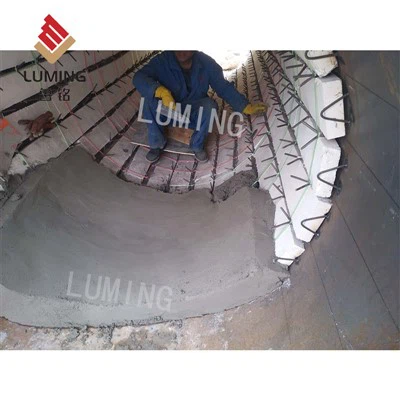
Hey there! As a supplier of ramming mass, I often get asked about the refractoriness of ramming mass. So, I thought I'd take a moment to break it down for you in a way that's easy to understand.
Let's start with the basics. Ramming mass is a type of unshaped refractory material that's used in various high - temperature applications. It's usually rammed or compacted into place to form a lining in furnaces, ladles, and other equipment that operates at extremely high temperatures.
Refractoriness, in simple terms, is the ability of a material to withstand high temperatures without melting, deforming, or losing its physical and chemical properties. When it comes to ramming mass, refractoriness is a crucial characteristic because it determines how well the material can perform in a high - temperature environment.
There are several factors that can affect the refractoriness of ramming mass. The first and most obvious one is the chemical composition. Different types of ramming mass are made from various raw materials, each with its own unique high - temperature properties.
For example, Sic - based Ramming Mix contains silicon carbide (SiC). Silicon carbide is known for its excellent thermal conductivity and high melting point. It can withstand very high temperatures and is resistant to thermal shock. This makes Sic - based ramming mix suitable for applications where rapid temperature changes occur, like in some types of steelmaking furnaces.
Another type is Zirconia - based Ramming Mix. Zirconia has a very high melting point and is highly resistant to chemical attack. It's often used in applications where the ramming mass needs to be in contact with corrosive substances at high temperatures, such as in some specialized ceramic firing kilns.
Magnesia - based Ramming Mix is also quite popular. Magnesia (MgO) has good refractoriness and is relatively inexpensive. It's commonly used in steelmaking ladles and basic oxygen furnaces because it can withstand the high temperatures and basic slag conditions present in these environments.
The particle size distribution of the raw materials in the ramming mass also plays a role in its refractoriness. A well - graded particle size distribution can lead to better packing density. When the particles are packed more closely together, the ramming mass has fewer voids. Fewer voids mean better heat transfer and less chance of the material breaking down under high temperatures.
The manufacturing process of ramming mass is another important factor. How the raw materials are mixed, milled, and treated can affect the final refractoriness. For instance, proper sintering during the manufacturing process can improve the strength and refractoriness of the ramming mass. If the sintering is not done correctly, the ramming mass may have weak spots that can fail at high temperatures.
The way the ramming mass is installed and maintained also impacts its ability to withstand high temperatures. During installation, it's essential to ram the material properly to achieve the right density. If it's not rammed tightly enough, there will be air pockets, which can lead to uneven heat distribution and premature failure.
Maintenance is equally important. Regular inspections can help detect any signs of wear or damage early on. If there are cracks or areas where the ramming mass has eroded, timely repairs can prevent further deterioration and extend the service life of the lining.
Now, let's talk about how we measure the refractoriness of ramming mass. One common method is the pyrometric cone equivalent (PCE) test. In this test, small cones made from the ramming mass are heated in a furnace along with standard reference cones. As the temperature rises, the cones start to bend. The PCE is determined by comparing the bending of the test cone to the reference cones. It gives an indication of the temperature at which the ramming mass will start to deform.
Another way to evaluate refractoriness is through thermal analysis techniques. Differential thermal analysis (DTA) and thermogravimetric analysis (TGA) can provide information about the physical and chemical changes that occur in the ramming mass as it's heated. These techniques can help us understand at what temperatures phase transitions, decomposition, or other reactions take place.
In real - world applications, the refractoriness of ramming mass can have a significant impact on the efficiency and cost - effectiveness of industrial processes. A high - quality ramming mass with good refractoriness can reduce the frequency of lining replacements. This means less downtime for the equipment, which translates into higher productivity.
For example, in a steelmaking plant, if the ramming mass lining in the furnace fails prematurely due to poor refractoriness, the plant has to shut down for repairs. This not only costs money in terms of lost production but also in the cost of new ramming mass and labor for replacement.


On the other hand, using a ramming mass with excellent refractoriness can lead to longer lining life, better heat transfer, and more consistent product quality. In a ceramic manufacturing facility, a well - performing ramming mass lining in the kiln can ensure that the ceramics are fired evenly and to the right specifications.
As a supplier, I always strive to provide ramming mass with the best possible refractoriness. We source high - quality raw materials, use advanced manufacturing processes, and conduct rigorous quality control tests. Our goal is to offer products that meet the specific needs of our customers in different industries.
If you're in the market for ramming mass and are concerned about its refractoriness, don't hesitate to reach out. We can discuss your application requirements in detail and recommend the most suitable type of ramming mass for your needs. Whether you're in the steel, ceramic, or any other high - temperature industry, we've got the expertise to help you make the right choice.
In conclusion, refractoriness is a key characteristic of ramming mass. It's determined by factors such as chemical composition, particle size distribution, manufacturing process, installation, and maintenance. By understanding these factors, you can make an informed decision when choosing ramming mass for your high - temperature applications. So, if you have any questions or are interested in purchasing ramming mass, just get in touch, and we'll work together to find the perfect solution for you.
References
- Some general textbooks on refractory materials which discuss the properties and applications of ramming mass.
- Industry reports on the performance of different types of ramming mass in various high - temperature processes.