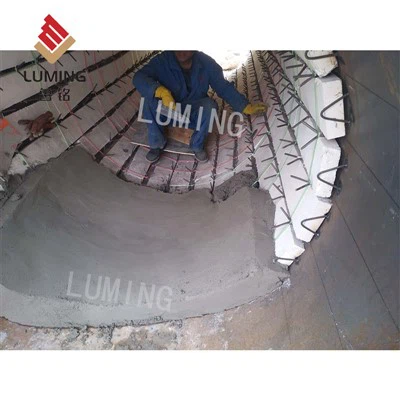
Hey there! As a supplier of corundum bricks, I've got a lot to share about what makes these bricks so special. In this blog, I'll break down the composition of corundum bricks, talk about their types, and why they're a top - choice in many industries.
Let's start with the basics. Corundum is a crystalline form of aluminum oxide (Al₂O₃). It's an extremely hard and chemically stable mineral, which is why it's a key ingredient in corundum bricks. The high content of aluminum oxide gives corundum bricks their remarkable properties, like high refractoriness, good thermal shock resistance, and excellent chemical stability.
Main Components of Corundum Bricks
Aluminum Oxide (Al₂O₃)
The most significant component of corundum bricks is aluminum oxide. Depending on the type of corundum brick, the Al₂O₃ content can range from about 90% to over 99%. High - purity corundum bricks with a very high Al₂O₃ content are used in applications where extreme heat resistance and chemical inertness are required. For example, in the lining of high - temperature furnaces in the steel and glass industries. The high melting point of aluminum oxide (around 2072°C) allows these bricks to withstand the intense heat without melting or deforming easily.


Other Oxides
Besides aluminum oxide, corundum bricks may also contain small amounts of other oxides. These can include silicon dioxide (SiO₂), titanium dioxide (TiO₂), and iron oxide (Fe₂O₃). Silicon dioxide can act as a fluxing agent during the firing process, helping to bind the corundum particles together. However, too much SiO₂ can reduce the refractoriness of the brick, so its content is carefully controlled. Titanium dioxide can improve the thermal shock resistance of the brick, making it more resistant to cracking when exposed to rapid temperature changes. Iron oxide, on the other hand, is usually present as an impurity. High levels of iron oxide can have a negative impact on the properties of the brick, such as reducing its chemical stability and increasing its thermal conductivity.
Types of Corundum Bricks and Their Compositions
Refractory Corundum Brick
Refractory Corundum Brick is one of the most common types. These bricks typically have an Al₂O₃ content of around 90 - 95%. They are designed to withstand high temperatures in industrial furnaces, kilns, and other high - heat applications. In addition to aluminum oxide, they may contain small amounts of other oxides like SiO₂ and TiO₂ to enhance certain properties. For example, a small amount of SiO₂ can help improve the bonding between the corundum grains, while TiO₂ can increase the thermal shock resistance.
Chrome - corundum Brick
Chrome - corundum Brick is another important type. As the name suggests, these bricks contain chromium oxide (Cr₂O₃) in addition to corundum. The addition of chromium oxide improves the chemical resistance of the brick, especially against acidic and basic slags. The Al₂O₃ content in chrome - corundum bricks is usually around 80 - 90%, and the Cr₂O₃ content can range from 5 - 20%. This combination makes them ideal for use in environments where the brick will come into contact with corrosive materials, such as in the non - ferrous metal smelting industry.
Fused Corundum Brick
Fused Corundum Brick is made by fusing high - purity alumina in an electric arc furnace. These bricks have an extremely high Al₂O₃ content, often over 99%. The fused process creates a dense and uniform structure, which gives the bricks excellent mechanical strength, high refractoriness, and low porosity. Fused corundum bricks are used in the most demanding high - temperature applications, such as in the glass - making industry, where they need to resist the corrosive action of molten glass and high - temperature gases.
Why Choose Our Corundum Bricks
As a supplier, we take pride in offering high - quality corundum bricks. Our bricks are carefully formulated to meet the specific needs of different industries. We control the composition of our bricks to ensure consistent quality and performance. Whether you need a refractory corundum brick for a general - purpose furnace or a fused corundum brick for a high - end glass - making application, we've got you covered.
Our manufacturing process is state - of - the - art, using the latest technology to produce bricks with the best possible properties. We also conduct strict quality control tests at every stage of production to make sure that our bricks meet or exceed industry standards.
Contact Us for Your Corundum Brick Needs
If you're in the market for corundum bricks, don't hesitate to get in touch. We're here to help you find the right type of corundum brick for your specific application. Whether you're a small - scale manufacturer or a large industrial company, we can provide you with the bricks you need at a competitive price. Just reach out to us, and we'll work with you to understand your requirements and offer the best solution.
References
- Schneider, H., & Haschke, C. (2008). Refractory Materials. Wiley - VCH Verlag GmbH & Co. KGaA.
- Reed, J. S. (1995). Principles of Ceramic Processing. John Wiley & Sons.