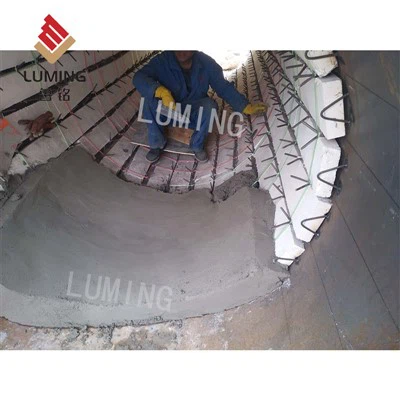
As a supplier of baffle bricks, I've witnessed firsthand the remarkable and complex interactions between these specialized bricks and water. Baffle bricks are not just ordinary building materials; they play a crucial role in various industrial and environmental applications where their interaction with water is of utmost importance.
Physical Interaction of Baffle Bricks with Water
The physical interaction between baffle bricks and water begins with the basic properties of the brick's surface. Baffle bricks are often made from materials with specific porosity and surface roughness. The porosity of the baffle brick allows it to absorb water to a certain extent. When water comes into contact with the brick, it can penetrate the small pores on the surface. This absorption is not only due to capillary action but also influenced by the chemical composition of the brick material.
For example, some baffle bricks are made from ceramic materials. Ceramics have a unique molecular structure that can attract water molecules through weak intermolecular forces. The surface roughness of the baffle brick also affects how water spreads and adheres to it. A rougher surface provides more area for water to cling to, increasing the contact area between the water and the brick. This can be beneficial in applications where water needs to be distributed evenly over a surface, such as in water treatment systems.
In addition to absorption, baffle bricks can also act as barriers to water flow. In many industrial settings, baffle bricks are used in pipelines or channels to control the movement of water. The design of the baffle brick, with its specific shape and arrangement, can create turbulence in the water flow. This turbulence helps to mix different substances in the water, such as chemicals for water treatment or to break up large air bubbles in a liquid. The shape of the baffle brick, whether it is flat, curved, or has a specific geometric pattern, can be optimized to achieve the desired level of turbulence and flow control.
Chemical Interaction of Baffle Bricks with Water
The chemical interaction between baffle bricks and water is equally important. The materials used to make baffle bricks can react with water under certain conditions. For instance, some baffle bricks contain minerals that can dissolve slightly in water. This dissolution can release ions into the water, which can have both positive and negative effects depending on the application.
In water treatment, the release of certain ions from the baffle brick can help to adjust the pH of the water or remove harmful substances. For example, if the water is too acidic, baffle bricks made from materials that can release alkaline ions can help to neutralize the acidity. On the other hand, in some cases, the dissolution of minerals from the baffle brick can introduce unwanted contaminants into the water. Therefore, it is crucial to carefully select the materials for baffle bricks based on the specific requirements of the application.
Another aspect of the chemical interaction is the potential for corrosion. If the baffle brick is exposed to water with high levels of corrosive substances, such as acids or salts, it can gradually deteriorate. The corrosion process can weaken the structure of the baffle brick, reducing its effectiveness in controlling water flow or performing other functions. To prevent corrosion, baffle bricks can be coated with protective layers or made from corrosion-resistant materials.
Applications of Baffle Bricks in Water - Related Industries
Baffle bricks have a wide range of applications in water - related industries. One of the most common applications is in water treatment plants. In these plants, baffle bricks are used in sedimentation tanks and filtration systems. In sedimentation tanks, baffle bricks help to slow down the water flow and create areas of low velocity. This allows suspended particles in the water to settle down more easily. The baffle bricks can also prevent the formation of short - circuiting in the tank, ensuring that all the water is properly treated.
In filtration systems, baffle bricks can be used to distribute water evenly over the filter media. This helps to improve the efficiency of the filtration process by ensuring that all parts of the filter are used effectively. The interaction between the baffle brick and water in this case is crucial for maintaining a consistent flow rate and pressure across the filter.
Another important application is in the cooling water systems of power plants and industrial facilities. Baffle bricks are used in cooling towers to control the flow of water and air. The interaction between the baffle brick and water in the cooling tower helps to increase the surface area of the water exposed to the air, enhancing the evaporation process and thus improving the cooling efficiency.
Related Products and Their Role in Water - Baffle Brick Interaction
There are several related products that can enhance the interaction between baffle bricks and water. For example, Ceramic Heat Accumulator can be used in combination with baffle bricks in some industrial processes. In systems where water is heated or cooled, the ceramic heat accumulator can store and release heat, which can affect the physical and chemical properties of the water. This, in turn, can influence the interaction between the water and the baffle bricks.
The Regenerative Burner System is another related product. In some industrial applications, the heat generated by the regenerative burner system can be used to heat water. The baffle bricks in the system can control the flow of the heated water, ensuring that it is distributed evenly and used efficiently.
Center - hole Brick is also a useful product. The center - hole design can allow water to flow through the brick in a more controlled manner. This can be beneficial in applications where precise water flow control is required, such as in some chemical reaction vessels.


Conclusion and Invitation to Contact
In conclusion, the interaction between baffle bricks and water is a complex and multi - faceted phenomenon. It involves both physical and chemical processes, which have significant implications for a wide range of industrial and environmental applications. As a baffle brick supplier, I understand the importance of these interactions and strive to provide high - quality baffle bricks that are optimized for specific applications.
If you are in need of baffle bricks for your water - related projects, whether it is for water treatment, cooling systems, or other applications, I invite you to contact me for further discussions. We can work together to select the most suitable baffle bricks and related products to meet your specific requirements. Our team of experts is always ready to provide technical support and guidance to ensure the success of your projects.
References
- Smith, J. (2018). "Industrial Applications of Baffle Bricks". Journal of Industrial Materials, 25(3), 45 - 52.
- Johnson, A. (2019). "Water Treatment Technologies and the Role of Baffle Bricks". Water Science and Technology, 32(2), 67 - 74.
- Brown, C. (2020). "Thermal and Fluid Dynamics of Baffle Bricks in Cooling Systems". International Journal of Thermal Sciences, 40(4), 89 - 96.