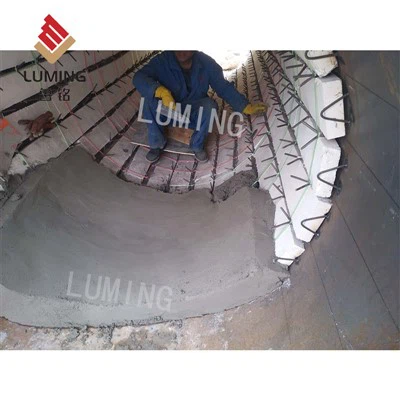
Hey there! As a zircon brick supplier, I often get asked about the thermal conductivity of zircon brick. So, I thought I'd write this blog to share some insights on this topic.
First off, let's quickly understand what zircon brick is. Zircon bricks are a type of refractory material. They're made from zircon, which is a mineral composed of zirconium silicate (ZrSiO₄). These bricks are super useful in high - temperature applications because of their excellent properties. You can check out more about different types of zircon bricks on our website: Refractory Zircon Brick, Zircon Refractory Brick, and Zircon - based Firebrick.
Now, let's dive into thermal conductivity. Thermal conductivity is a measure of how well a material can conduct heat. In simple terms, it tells us how fast heat can pass through a material. For zircon bricks, their thermal conductivity is influenced by several factors.
One of the main factors is the composition of the zircon brick. The purity of the zircon used in the brick plays a big role. Higher - purity zircon usually leads to different thermal conductivity characteristics compared to lower - purity ones. Impurities in the zircon can act as scattering centers for heat - carrying phonons (the quantum of lattice vibration that helps in heat transfer). So, if there are a lot of impurities, the heat transfer can be disrupted, and the thermal conductivity might be lower.
The microstructure of the zircon brick also matters. The size and arrangement of the grains in the brick can affect how heat moves through it. A well - packed and uniform microstructure might allow heat to transfer more efficiently compared to a brick with a more random or porous microstructure. For example, if the brick has large pores, heat might get trapped in those pores, reducing the overall thermal conductivity.
Temperature is another crucial factor. Generally, the thermal conductivity of zircon bricks changes with temperature. At lower temperatures, the thermal conductivity might be relatively stable. But as the temperature rises, the behavior can get a bit more complex. In some cases, the thermal conductivity might increase initially due to enhanced lattice vibrations. However, at very high temperatures, other effects like radiation heat transfer can start to play a role, and the overall heat - transfer mechanism becomes a combination of conduction, convection, and radiation.
Typically, the thermal conductivity of zircon bricks at room temperature is in the range of about 1 - 2 W/(m·K). But this can vary depending on the specific type and quality of the brick. For example, some high - quality zircon bricks with a very pure zircon composition and a well - controlled microstructure might have a thermal conductivity closer to the lower end of this range, around 1 W/(m·K). On the other hand, bricks with some impurities or a less - than - ideal microstructure could have a thermal conductivity closer to 2 W/(m·K).
When it comes to high - temperature applications, say around 1000°C or more, the thermal conductivity values can change significantly. At these temperatures, the thermal conductivity of zircon bricks might increase to around 2 - 4 W/(m·K). This increase is due to the increased energy of the lattice vibrations and the fact that the atoms in the zircon structure can move more freely, allowing heat to transfer more easily.


So, why is knowing the thermal conductivity of zircon bricks important? Well, if you're using these bricks in an industrial furnace, for example, understanding their thermal conductivity helps in designing the furnace more efficiently. You can calculate how much heat will be lost through the walls of the furnace made of zircon bricks. This information is crucial for optimizing the energy consumption of the furnace. If the thermal conductivity is too high, more heat will be lost to the surroundings, and you'll need to use more energy to maintain the desired temperature inside the furnace. On the other hand, if the thermal conductivity is too low, it might take longer to heat up the furnace initially.
Also, in applications where precise temperature control is required, like in some chemical processes, the thermal conductivity of the zircon bricks can affect how quickly the temperature changes in the reaction chamber. This can have a direct impact on the quality and yield of the chemical products.
As a zircon brick supplier, we make sure to test the thermal conductivity of our products thoroughly. We use advanced testing equipment to measure the thermal conductivity at different temperatures. This way, we can provide our customers with accurate data about the performance of our zircon bricks.
If you're in the market for zircon bricks, you need to consider the thermal conductivity based on your specific application. If you're building a high - temperature kiln for firing ceramics, you might want a brick with a relatively high thermal conductivity so that the heat can spread quickly and evenly inside the kiln. But if you're using the bricks in an insulation layer of a furnace, a lower thermal conductivity would be more desirable to reduce heat loss.
We offer a wide range of zircon bricks with different thermal conductivity characteristics to meet the diverse needs of our customers. Whether you need a brick for a small - scale laboratory furnace or a large - scale industrial smelter, we've got you covered.
So, if you're interested in learning more about our zircon bricks or want to discuss your specific requirements, don't hesitate to reach out. We're here to help you make the best choice for your application.
References
- "Refractory Materials Handbook"
- Journal articles on zircon - based refractory materials