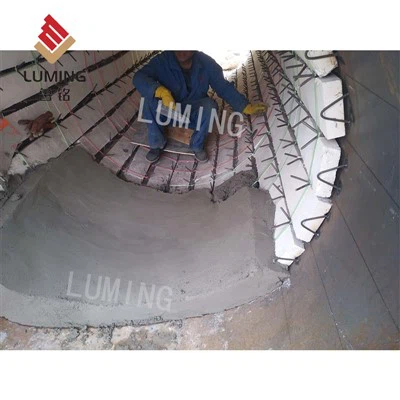
Refractory mortar is a crucial material in high - temperature industrial applications, playing a vital role in various sectors such as metallurgy, glass manufacturing, and ceramics production. One of the fundamental distinctions among different types of refractory mortar is whether they contain carbon or are carbon - free. As a refractory mortar supplier, understanding these differences is essential for providing the best products to our customers.
1. Chemical Composition
Carbon - containing Refractory Mortar
Carbon - containing refractory mortar typically includes carbonaceous materials such as graphite, carbon black, or pitch. These carbon components are added to enhance certain properties of the mortar. For example, graphite has excellent thermal conductivity, which allows the mortar to quickly transfer heat. This is beneficial in applications where rapid heat dissipation is required. Additionally, carbon has a high melting point and good chemical stability, making it resistant to many corrosive substances at high temperatures.
The carbon in the mortar can also form a protective layer on the surface of the refractory lining during use. This layer can prevent the penetration of molten metals, slags, and other aggressive agents, thereby extending the service life of the refractory structure. However, the presence of carbon also has some drawbacks. Carbon is prone to oxidation at high temperatures in the presence of oxygen. Once oxidized, the mechanical strength and integrity of the mortar can be significantly reduced, leading to potential failure of the refractory lining.
Carbon - free Refractory Mortar
In contrast, carbon - free refractory mortar is mainly composed of inorganic oxides such as alumina (Al₂O₃), silica (SiO₂), and magnesia (MgO). Different combinations of these oxides can result in various types of carbon - free refractory mortars, each with its own unique properties. For instance, Corundum Refractory Slurry, which is rich in alumina, has high hardness, excellent wear resistance, and good thermal shock resistance. It is suitable for use in areas with severe abrasion and high - temperature fluctuations.
Silica Refractory Mud contains a high proportion of silica. Silica has a relatively low thermal expansion coefficient, which makes the mortar suitable for applications where dimensional stability is critical. It also has good corrosion resistance against acidic substances, making it a popular choice in the glass industry.
Fireclay Refractory Mortar is composed of fireclay, which is a type of clay mineral with high alumina content. It has moderate refractory properties and is cost - effective, making it widely used in general industrial furnaces and kilns.
2. Physical Properties
Thermal Conductivity
Carbon - containing refractory mortar generally has higher thermal conductivity compared to carbon - free refractory mortar. The carbon in the mortar acts as a heat - conducting bridge, allowing heat to transfer more efficiently through the material. This property can be an advantage in some applications, such as in induction furnaces where efficient heat transfer is necessary for the melting process.
On the other hand, carbon - free refractory mortar often has lower thermal conductivity. This can be beneficial in applications where heat insulation is required, such as in the walls of high - temperature furnaces. By reducing heat loss through the refractory lining, energy consumption can be significantly reduced, leading to cost savings for the customers.
Mechanical Strength
At normal temperatures, the mechanical strength of carbon - containing and carbon - free refractory mortars can vary depending on their formulation. However, at high temperatures, the mechanical strength of carbon - containing mortar may be affected by carbon oxidation. As the carbon is oxidized, the mortar may lose its structural integrity, resulting in a decrease in strength.
Carbon - free refractory mortar, especially those with high - quality oxide components, can maintain relatively stable mechanical strength at high temperatures. For example, corundum - based refractory mortar has high compressive strength and flexural strength, which can withstand the mechanical stresses generated during the operation of industrial furnaces.
Thermal Expansion
The thermal expansion behavior of the two types of refractory mortar is also different. Carbon - containing refractory mortar usually has a relatively high thermal expansion coefficient, mainly due to the significant expansion of carbon at high temperatures. This can cause problems in applications where dimensional stability is crucial, as the expansion may lead to cracking and spalling of the refractory lining.
Carbon - free refractory mortar can be formulated to have a low thermal expansion coefficient. For instance, silica - based refractory mortar has a very low thermal expansion, which allows it to maintain its shape and integrity even under large temperature fluctuations.
3. Chemical Resistance
Resistance to Molten Metals and Slags
Carbon - containing refractory mortar has good resistance to some molten metals, especially non - ferrous metals such as copper and aluminum. The carbon in the mortar can form a protective layer on the surface, preventing the direct contact of the molten metal with the refractory material. However, it may be less resistant to some slags, especially those with high oxygen - containing components, as the carbon can react with the oxygen in the slag.
Carbon - free refractory mortar can be designed to have excellent resistance to different types of slags. For example, magnesia - based refractory mortar is highly resistant to basic slags, while alumina - based mortar is suitable for acidic slags. By choosing the appropriate carbon - free refractory mortar, the corrosion of the refractory lining by slags can be effectively reduced.
Resistance to Chemical Gases
In industrial environments, various chemical gases are often present. Carbon - containing refractory mortar may be susceptible to oxidation by oxygen - containing gases at high temperatures. Additionally, some reactive gases such as sulfur - containing gases can react with the carbon in the mortar, leading to its degradation.
Carbon - free refractory mortar generally has better resistance to chemical gases. For example, silica - based refractory mortar can resist the corrosion of some acidic gases, while alumina - based mortar is relatively stable in the presence of many chemical gases.
4. Applications
Carbon - containing Refractory Mortar
Due to its high thermal conductivity and relatively good resistance to some molten metals, carbon - containing refractory mortar is often used in applications such as ladles in the steelmaking industry, where it helps to quickly transfer heat and protect the ladle lining from molten steel. It is also used in some non - ferrous metal smelting processes, such as the production of copper and aluminum.
Carbon - free Refractory Mortar
Carbon - free refractory mortar has a wide range of applications. Corundum Refractory Slurry is commonly used in the lining of high - temperature furnaces in the cement and ceramics industries, where it can withstand high temperatures and severe abrasion. Silica Refractory Mud is widely used in the glass industry, as it can ensure the dimensional stability of the glass melting furnace and resist the corrosion of glass melt. Fireclay Refractory Mortar is used in general industrial furnaces and small - scale kilns, providing a cost - effective solution for high - temperature applications.
5. Conclusion and Call to Action
As a refractory mortar supplier, we understand that choosing the right type of refractory mortar is crucial for the success of our customers' high - temperature applications. Whether it is carbon - containing or carbon - free refractory mortar, each has its own unique advantages and disadvantages. We are committed to providing our customers with high - quality refractory mortar products and professional technical support.


If you are in need of refractory mortar for your industrial project, we encourage you to contact us for procurement and negotiation. Our experienced sales team will work closely with you to understand your specific requirements and recommend the most suitable refractory mortar products. We look forward to establishing a long - term and mutually beneficial partnership with you.
References
- "Refractory Materials Handbook", edited by John Smith, published by Industrial Press, 2018.
- "High - Temperature Materials and Their Applications", written by David Brown, published by Academic Press, 2020.
- Technical reports from relevant research institutions on refractory materials.