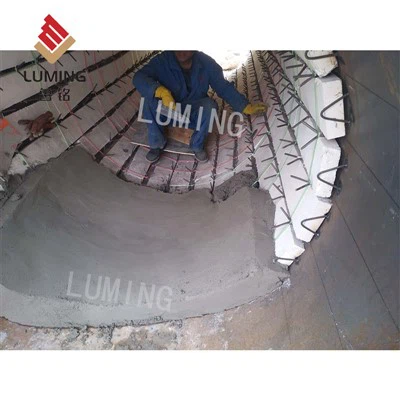
Ramming mass is a crucial refractory material used in various industrial applications, especially in furnaces and other high - temperature environments. As a leading ramming mass supplier, understanding and explaining the density of ramming mass is essential for both our team and our potential customers.
Understanding Density Basics
Density is a fundamental physical property that describes the mass of a substance per unit volume. In the metric system, it is usually expressed in grams per cubic centimeter (g/cm³) or kilograms per cubic meter (kg/m³). For ramming mass, density plays a significant role in its performance, application, and overall quality.
High - density ramming mass generally indicates a more compact and less porous structure. This can lead to better resistance to high temperatures, improved mechanical strength, and enhanced chemical stability. On the other hand, lower - density ramming mass may offer advantages such as better insulation properties, which can be beneficial in certain applications where energy efficiency and heat retention are important.
Factors Affecting the Density of Ramming Mass
Raw Materials
The choice of raw materials is one of the most significant factors influencing the density of ramming mass. Different base materials have different inherent densities. For example, Zirconia-based Ramming Mix typically has a relatively high density due to the high atomic mass of zirconium. Zirconia has excellent refractory properties and a high melting point, and when used as a base material for ramming mass, it contributes to a denser final product.
In contrast, Magnesia-based Ramming Mix may have a different density range. Magnesia is known for its good thermal stability and basicity, but its density characteristics are distinct from zirconia - based mixes. The purity and particle size distribution of the magnesia powder used in the ramming mass also affect its density. Finer particles can pack more closely together, potentially increasing the density of the ramming mass.
Sic-based Ramming Mix is another type of ramming mass. Silicon carbide has a relatively low density compared to some other refractory materials. However, it offers excellent thermal conductivity and abrasion resistance. The density of Sic - based ramming mass can be adjusted by controlling the composition and the amount of additives used in the manufacturing process.
Particle Size Distribution
The particle size distribution of the raw materials used in ramming mass has a direct impact on its density. A well - graded particle size distribution, where there is a combination of different particle sizes, allows for better packing of the particles. Smaller particles can fill the voids between larger particles, resulting in a more compact structure and higher density.
If the particle size is too uniform, there will be more voids in the ramming mass, leading to a lower density. Manufacturers often optimize the particle size distribution to achieve the desired density and other performance properties of the ramming mass.
Manufacturing Process
The manufacturing process of ramming mass also affects its density. During the mixing process, the thoroughness of blending the raw materials is crucial. Incomplete mixing can lead to non - uniform density within the ramming mass.
The compaction process is another important step. Higher compaction pressures during installation can increase the density of the ramming mass. For example, in the case of ramming the mass into a furnace lining, the force applied during ramming can significantly impact the final density of the lining. The use of vibration or other compaction techniques can also help to achieve a higher density.
Density Ranges of Different Ramming Masses
Zirconia - based Ramming Mass
The density of zirconia - based ramming mass typically ranges from about 3.5 g/cm³ to 5.5 g/cm³. The exact density depends on the specific formulation, including the purity of the zirconia, the type and amount of additives, and the manufacturing process. Higher - purity zirconia and more effective compaction methods usually result in ramming mass with a density closer to the upper end of this range.


Magnesia - based Ramming Mass
Magnesia - based ramming mass generally has a density in the range of 2.5 g/cm³ to 3.5 g/cm³. The density can be influenced by factors such as the magnesia source (e.g., natural magnesite or synthetic magnesia), the particle size distribution, and the presence of binders or other additives. For applications where high - temperature stability and resistance to basic slags are required, a higher - density magnesia - based ramming mass may be preferred.
Sic - based Ramming Mass
The density of Sic - based ramming mass is relatively lower compared to zirconia - based ramming mass, typically ranging from 1.8 g/cm³ to 2.8 g/cm³. This lower density is due to the relatively low atomic mass of silicon carbide. However, despite its lower density, Sic - based ramming mass offers unique properties such as high thermal conductivity and excellent abrasion resistance, which make it suitable for specific industrial applications, such as in the lining of aluminum melting furnaces.
Importance of Density in Ramming Mass Applications
High - Temperature Resistance
In high - temperature applications, such as in steelmaking furnaces, the density of ramming mass is closely related to its ability to withstand extreme heat. A higher - density ramming mass has a more compact structure, which can better resist the penetration of hot gases and molten metals. This reduces the risk of erosion and corrosion, extending the service life of the furnace lining.
Mechanical Strength
Density also affects the mechanical strength of ramming mass. A denser ramming mass is generally stronger and more resistant to mechanical stress, such as the impact of charging materials or the movement of molten metal within the furnace. This is particularly important in applications where the ramming mass is subject to frequent mechanical forces.
Insulation Properties
In some applications, such as in heat - treating furnaces, the insulation properties of ramming mass are crucial. Lower - density ramming mass can provide better insulation, reducing heat loss and improving energy efficiency. By carefully selecting the density of the ramming mass, manufacturers can optimize the thermal performance of the furnace.
Choosing the Right Density for Your Application
As a ramming mass supplier, we understand that choosing the right density for a specific application is crucial. Our team of experts can work closely with customers to analyze their requirements, including the operating temperature, the type of molten metal or slag involved, and the mechanical stress conditions.
For applications that require high - temperature resistance and mechanical strength, such as in large - scale steelmaking furnaces, a higher - density ramming mass, such as zirconia - based or high - quality magnesia - based ramming mass, may be recommended. On the other hand, for applications where insulation is a priority, a lower - density ramming mass, such as Sic - based ramming mass, could be a better choice.
Contact Us for Ramming Mass Procurement
If you are in the market for ramming mass and need more information about density, types, or applications, we are here to help. Our experienced team can provide detailed technical advice and support to ensure that you select the most suitable ramming mass for your specific needs. Whether you are a small - scale foundry or a large industrial enterprise, we have the products and expertise to meet your requirements. Contact us today to start a procurement discussion and find the perfect ramming mass solution for your business.
References
- "Refractories Handbook", Second Edition, Edited by Peter J. F. Harris
- "High - Temperature Materials and Technologies", Various Authors, Published by Elsevier
- Industry reports on refractory materials from leading research institutions.