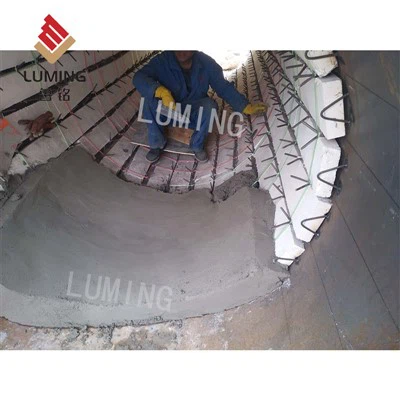
As a supplier of Spray Nozzle Bricks, I've been deeply involved in understanding the ins and outs of these crucial components. Spray Nozzle Bricks play a vital role in various industrial applications, especially in high - temperature environments such as those found in the metallurgical and glass industries. One of the most important aspects to consider when dealing with Spray Nozzle Bricks is their mechanical strength.
Understanding Mechanical Strength in General
Mechanical strength refers to the ability of a material to withstand external forces without undergoing significant deformation or failure. In the case of Spray Nozzle Bricks, these external forces can come from multiple sources. For instance, during the operation of a Regenerative Burner System, the bricks are exposed to high - pressure gas flows, thermal stresses, and in some cases, abrasive materials carried by the gas.
There are several types of mechanical strength that are relevant to Spray Nozzle Bricks. Compressive strength is perhaps the most well - known. It measures the ability of the brick to resist forces that attempt to compress it. In industrial furnaces, high - pressure gas streams can exert a compressive force on the Spray Nozzle Bricks. If the compressive strength is not sufficient, the bricks may crack or break, leading to a disruption in the burner operation and potential safety hazards.
Tensile strength, on the other hand, is the ability of the material to resist forces that try to pull it apart. Although tensile forces are not as common as compressive forces in the context of Spray Nozzle Bricks, they can still occur due to thermal expansion and contraction. When the temperature inside the furnace changes rapidly, the bricks may experience differential expansion and contraction, which can create tensile stresses. If the tensile strength is low, the bricks may develop cracks, reducing their effectiveness and lifespan.
Shear strength is another important factor. It refers to the ability of the material to resist forces that act parallel to its surface. In a burner system, shear forces can be generated by the high - velocity gas flow around the Spray Nozzle Bricks. A low shear strength can cause the surface of the bricks to erode over time, affecting the shape and performance of the nozzles.
Factors Affecting the Mechanical Strength of Spray Nozzle Bricks
Material Composition
The material used to manufacture Spray Nozzle Bricks has a significant impact on their mechanical strength. Most Spray Nozzle Bricks are made from refractory materials such as alumina, silica, and zirconia. Alumina - based bricks are known for their high compressive strength and good thermal stability. They can withstand high temperatures and are resistant to chemical corrosion. Silica - based bricks, on the other hand, have relatively lower compressive strength but are more resistant to thermal shock. Zirconia - containing bricks offer a combination of high strength and good resistance to wear and corrosion.


The purity of the raw materials also matters. Impurities in the materials can weaken the structure of the bricks, reducing their mechanical strength. For example, the presence of iron oxide in alumina - based bricks can cause thermal expansion and contraction to be less uniform, leading to internal stresses and potential cracking.
Manufacturing Process
The way Spray Nozzle Bricks are manufactured can greatly affect their mechanical strength. The process typically involves mixing the raw materials, forming the bricks into the desired shape, and then firing them at high temperatures. The forming method can influence the density and uniformity of the bricks. For example, bricks formed by isostatic pressing tend to have a more uniform density compared to those formed by hand - molding or extrusion. A more uniform density generally results in higher mechanical strength.
The firing process is also crucial. The temperature and duration of firing determine the degree of sintering of the bricks. If the firing temperature is too low or the duration is too short, the bricks may not be fully sintered, resulting in a porous structure and low mechanical strength. On the other hand, over - firing can cause the bricks to become brittle and lose some of their strength.
Design and Geometry
The design and geometry of the Spray Nozzle Bricks can impact their mechanical strength. The shape of the nozzle, for example, can affect the distribution of forces within the brick. A well - designed nozzle can minimize stress concentrations, reducing the risk of cracking. Additionally, the thickness of the brick walls also plays a role. Thicker walls generally provide higher mechanical strength, but they also increase the weight and cost of the bricks.
Importance of Mechanical Strength in Industrial Applications
In industrial applications, the mechanical strength of Spray Nozzle Bricks is of utmost importance. In a Regenerative Burner System, the proper functioning of the Spray Nozzle Bricks is essential for efficient combustion. If the bricks are damaged due to insufficient mechanical strength, the gas flow may be disrupted, leading to incomplete combustion, increased energy consumption, and higher emissions.
In the glass industry, Spray Nozzle Bricks are used to introduce fuel and air into the furnace. The high - temperature and corrosive environment in the glass furnace require the bricks to have high mechanical strength and chemical resistance. Any failure of the Spray Nozzle Bricks can result in a decrease in glass quality and production efficiency.
In the metallurgical industry, where high - temperature melting and refining processes are carried out, the mechanical strength of Spray Nozzle Bricks is critical for maintaining the stability of the furnace operation. The bricks need to withstand the high - pressure gas flows and the abrasive action of the molten metal and slag. A breakdown of the Spray Nozzle Bricks can lead to costly downtime for repairs and replacements.
Testing the Mechanical Strength of Spray Nozzle Bricks
To ensure the quality and performance of Spray Nozzle Bricks, various testing methods are used to measure their mechanical strength. Compressive strength testing is typically carried out using a hydraulic press. A sample of the brick is placed between two platens, and a gradually increasing load is applied until the brick fails. The maximum load at failure is then used to calculate the compressive strength.
Tensile strength testing is more challenging as it is difficult to grip the brick sample without introducing additional stress concentrations. One common method is to use a dog - bone - shaped sample and apply a tensile force using a testing machine.
Shear strength testing can be performed using a shear - testing fixture. The sample is subjected to a shear force, and the maximum force at which the sample fails is measured to determine the shear strength.
Our Commitment as a Spray Nozzle Brick Supplier
As a leading supplier of Spray Nozzle Bricks, we are committed to providing products with high mechanical strength. We carefully select the raw materials, using only high - purity and high - quality refractory materials. Our manufacturing process is strictly controlled, ensuring that the bricks are formed and fired to the optimal specifications.
We also conduct comprehensive quality control tests on all our Spray Nozzle Bricks. This includes mechanical strength testing, as well as tests for thermal stability, chemical resistance, and porosity. By doing so, we can guarantee that our products meet or exceed the industry standards.
In addition to Spray Nozzle Bricks, we also offer Center - hole Bricks and other related products for regenerative burner systems. Our team of experts is always available to provide technical support and advice to our customers.
If you are in the market for high - quality Spray Nozzle Bricks or other refractory products, we invite you to contact us for a detailed discussion. We can help you select the most suitable products for your specific applications and provide you with competitive pricing and excellent service. Let's work together to ensure the efficient and reliable operation of your industrial processes.
References
- ASTM International. (Year). Standard test methods for compressive strength of refractory materials. ASTM C133 - XX.
- ISO. (Year). ISO standards for testing the mechanical properties of refractory products.
- Norton, F. H. (1974). Refractories. McGraw - Hill Book Company.