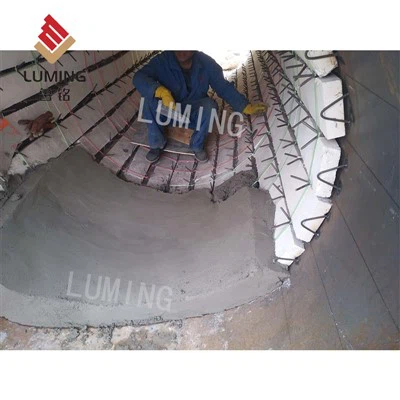
As a center - hole brick supplier, I've witnessed firsthand the importance of understanding the creep behavior of these bricks. Creep is a critical aspect that can significantly impact the performance and longevity of center - hole bricks in various industrial applications. In this blog, I'll delve into what the creep behavior of center - hole bricks is, its influencing factors, and its implications for industrial use.
What is Creep?
Creep refers to the time - dependent deformation that occurs in a material under a constant load at elevated temperatures. In the context of center - hole bricks, when these bricks are exposed to high temperatures and a continuous mechanical load over an extended period, they gradually deform. This deformation can be in the form of expansion, shrinkage, or a change in shape.
The creep process is complex and occurs in three stages: primary creep, secondary creep, and tertiary creep. In the primary creep stage, the deformation rate is relatively high initially but gradually decreases over time. This is due to the material's internal structure adjusting to the applied load. The secondary creep stage follows, where the deformation rate becomes relatively constant. This is the most stable stage and often the longest - lasting period during the service life of the center - hole brick. Finally, in the tertiary creep stage, the deformation rate accelerates rapidly, which can lead to the failure of the material.
Factors Influencing the Creep Behavior of Center - Hole Bricks
Temperature
Temperature is one of the most significant factors affecting the creep behavior of center - hole bricks. As the temperature increases, the atoms in the brick's material gain more energy and become more mobile. This increased atomic mobility allows the material to deform more easily under a load. For example, at relatively low temperatures, the creep rate of center - hole bricks may be negligible. However, when the temperature approaches or exceeds the material's softening point, the creep rate can increase exponentially. Industrial furnaces and kilns that operate at high temperatures, such as those used in the steel and glass industries, can subject center - hole bricks to extreme thermal conditions, which can accelerate the creep process.
Load
The magnitude of the applied load also plays a crucial role in the creep behavior of center - hole bricks. A higher load will generally result in a higher creep rate. In industrial applications, center - hole bricks may be subjected to various types of loads, including their own weight, the weight of other materials stacked on them, and the pressure from the surrounding environment. For instance, in a large - scale furnace, the bricks at the bottom of the structure may bear a significant load from the bricks above them. If the load exceeds the material's creep resistance, it can cause excessive deformation and potentially lead to structural failure.
Material Composition
The composition of the center - hole brick material is another key factor. Different materials have different atomic structures and bonding strengths, which directly affect their creep resistance. For example, bricks made from high - quality refractory materials with a dense and stable crystal structure tend to have better creep resistance than those made from lower - grade materials. The presence of impurities and additives in the material can also influence the creep behavior. Some additives can improve the material's high - temperature strength and reduce the creep rate, while impurities may act as weak points in the structure and accelerate the creep process.
Microstructure
The microstructure of the center - hole brick, including the grain size, porosity, and the distribution of phases, can have a profound impact on its creep behavior. A fine - grained microstructure generally provides better creep resistance because the smaller grains offer more grain boundaries, which can impede the movement of dislocations (defects in the crystal structure) and thus reduce the deformation rate. On the other hand, a high porosity can weaken the material and increase the creep rate, as the pores act as stress concentrators and provide pathways for atomic diffusion.
Implications of Creep Behavior in Industrial Applications
Structural Integrity
The creep behavior of center - hole bricks can have a direct impact on the structural integrity of industrial equipment. Excessive creep deformation can lead to cracking, spalling, and misalignment of the bricks. In a furnace or kiln, this can compromise the insulation properties of the lining, increase heat loss, and potentially cause the equipment to malfunction. For example, if the center - hole bricks in a furnace lining deform due to creep, it can create gaps between the bricks, allowing hot gases to escape and damage the surrounding structures.
Service Life
Understanding the creep behavior is essential for predicting the service life of center - hole bricks. By analyzing the creep rate under specific operating conditions, engineers can estimate how long the bricks will last before they need to be replaced. This information is crucial for planning maintenance schedules and reducing downtime in industrial operations. For instance, in a continuous - operation furnace, knowing the expected service life of the center - hole bricks can help the plant managers to order replacement bricks in advance and schedule maintenance during planned shutdowns.
Energy Efficiency
Creep deformation can also affect the energy efficiency of industrial processes. As the bricks deform, the insulation properties of the lining may deteriorate, leading to increased heat loss. This means that more energy is required to maintain the desired temperature in the furnace or kiln, resulting in higher operating costs. By using center - hole bricks with good creep resistance, industries can reduce heat loss and improve energy efficiency.
Comparison with Other Refractory Products
When comparing center - hole bricks with other refractory products such as Baffle Brick and Ceramic Heat Accumulator, the creep behavior shows some differences. Baffle bricks are often used to control the flow of gases in industrial furnaces. They may be subjected to different types of loads and thermal conditions compared to center - hole bricks. Generally, baffle bricks need to have good resistance to thermal shock in addition to creep resistance.
Ceramic heat accumulators, on the other hand, are designed to store and release heat efficiently. Their creep behavior is also important, as excessive deformation can reduce their heat - storage capacity and affect their performance. Center - hole bricks, with their unique structure, are often used in applications where gas flow and heat transfer need to be optimized. Their creep behavior needs to be carefully considered to ensure that they can maintain their shape and function over a long period.
Selecting Center - Hole Bricks with Good Creep Resistance
As a center - hole brick supplier, I understand the importance of providing products with excellent creep resistance. When customers are selecting center - hole bricks for their industrial applications, they should consider the following factors:
- Material Quality: Choose bricks made from high - quality refractory materials with a proven track record of good creep resistance.
- Testing and Certification: Look for bricks that have been tested under relevant standards and have the necessary certifications. This can provide assurance that the bricks meet the required performance criteria.
- Application - Specific Design: Consider the specific operating conditions of the industrial application, such as temperature, load, and gas environment. Select center - hole bricks that are designed to withstand these conditions.
Conclusion
In conclusion, the creep behavior of center - hole bricks is a complex but crucial aspect that can significantly impact their performance in industrial applications. Temperature, load, material composition, and microstructure are all important factors that influence the creep rate. Understanding the creep behavior is essential for ensuring the structural integrity, service life, and energy efficiency of industrial equipment. As a supplier of Center - Hole Brick, I am committed to providing high - quality products with excellent creep resistance. If you are in the market for center - hole bricks and have any questions or need further information, please feel free to contact me for procurement discussions.


References
- "Refractories Handbook" by J. A. Sullivan
- "High - Temperature Materials and Their Applications" by R. A. Rapp