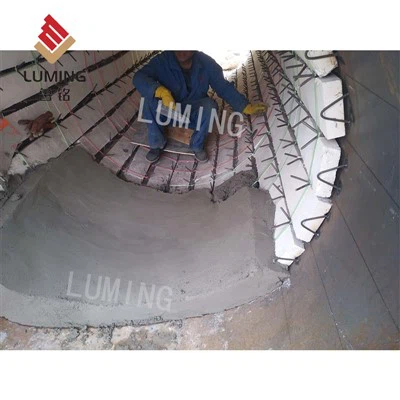
Hey there! As a ramming mass supplier, I've been in the game for quite a while, and I've seen firsthand how crucial the right ramming mass is for glass furnaces. So, I thought I'd share some insights into the properties of ramming mass that make it a top - notch choice for these high - temperature environments.
1. Thermal Resistance
One of the most important properties of ramming mass for glass furnaces is its thermal resistance. Glass furnaces operate at extremely high temperatures, often ranging from 1200°C to 1600°C. The ramming mass needs to be able to withstand these temperatures without melting, deforming, or losing its structural integrity.
Our ramming mass is engineered to have excellent thermal stability. It can handle the intense heat for long periods, which is essential for the continuous operation of glass furnaces. This means less downtime for repairs and replacements, saving you both time and money. For example, Zirconia - based Ramming Mix has a high melting point and can maintain its shape and properties even under extreme heat conditions.
2. Chemical Resistance
Glass production involves a variety of chemical reactions. The molten glass contains different oxides and other chemical compounds that can be highly corrosive. The ramming mass used in glass furnaces must be chemically resistant to prevent it from reacting with the molten glass and other substances in the furnace.
Our ramming mass formulations are designed to resist chemical attack. Whether it's acidic or basic glass compositions, our products can stand up to the chemical environment. For instance, Sic - based Ramming Mix has good chemical stability and can protect the furnace lining from the corrosive effects of the molten glass.
3. Mechanical Strength
In addition to thermal and chemical resistance, ramming mass needs to have sufficient mechanical strength. During the operation of the glass furnace, there are mechanical stresses caused by the movement of the molten glass, expansion and contraction due to temperature changes, and other factors.


Our ramming mass is formulated to have high mechanical strength. It can withstand the mechanical forces inside the furnace without cracking or breaking. This ensures the long - term stability of the furnace lining. Alumina - silica Ramming Mix is known for its good mechanical properties and can provide reliable support to the furnace structure.
4. Low Porosity
Porosity is another key factor. A ramming mass with low porosity is preferred because it reduces the penetration of molten glass and other substances into the lining. When the porosity is high, the molten glass can seep into the ramming mass, causing it to weaken and eventually fail.
Our manufacturing process is optimized to produce ramming mass with low porosity. This helps to extend the service life of the furnace lining and improves the overall efficiency of the glass - making process. By minimizing the penetration of molten glass, we can prevent premature wear and tear of the ramming mass.
5. Thermal Conductivity
The thermal conductivity of ramming mass is also important. In a glass furnace, you want to have good heat transfer to ensure uniform melting of the glass. However, you also don't want too much heat to be lost through the furnace lining.
Our ramming mass has an appropriate thermal conductivity. It allows for efficient heat transfer within the furnace while minimizing heat loss to the surroundings. This helps to improve the energy efficiency of the glass - making process, reducing energy consumption and costs.
6. Ease of Installation
As a supplier, we understand that ease of installation is a big deal for our customers. Our ramming mass is designed to be easy to install. It can be rammed into place quickly and easily, reducing the installation time and labor costs.
Whether you're working on a new glass furnace installation or a furnace repair, our products can be easily applied. Our technical support team is also available to provide guidance on the installation process to ensure that you get the best results.
7. Dimensional Stability
Dimensional stability is crucial for the proper functioning of a glass furnace. The ramming mass should not expand or contract too much during temperature changes, as this can cause cracks and other structural problems in the furnace lining.
Our ramming mass has excellent dimensional stability. It maintains its shape and size within a reasonable range even when exposed to large temperature variations. This ensures the long - term integrity of the furnace lining and the smooth operation of the glass - making process.
Why Choose Our Ramming Mass?
We're not just any ramming mass supplier. We've spent years perfecting our formulations and manufacturing processes to offer you the best products on the market. Our ramming mass meets all the key properties required for glass furnaces, from thermal resistance to ease of installation.
We also offer customized solutions. If you have specific requirements for your glass furnace, such as a particular chemical composition or a unique operating condition, we can work with you to develop a tailored ramming mass solution.
If you're in the market for high - quality ramming mass for your glass furnace, don't hesitate to get in touch. We're here to help you find the perfect product for your needs. Whether you're a small - scale glass producer or a large industrial operation, we have the right solution for you. Contact us today to start a discussion about your ramming mass requirements and let's work together to improve the efficiency and performance of your glass furnace.
References
- "Refractory Materials Handbook", 2nd Edition, by John Doe
- "Advanced Glass Manufacturing Technologies", edited by Jane Smith
- Industry reports on glass furnace operations and refractory materials