


Shandong Luming New Materials Technology Co., Ltd. is one of the leading manufacturers and suppliers of phosphate-bonded high alumina brick in China. We have world-leading production equipment and strong manufacturing capabilities. Please feel free to buy premium phosphate-bonded high alumina brick at competitive price from our factory.
Phosphate bonded alumina brick uses high-alumina material (typically containing Al₂O₃ ≥ 48%) as the main raw material and employs phosphoric acid or phosphate as a chemical binder.The phosphate binder reacts with the Al₂O₃ in the high-alumina material at medium-to-low temperatures, forming aluminum phosphate compounds, thereby achieving strength even at relatively low temperatures.
Characteristics of Phosphate Bonded High Alumina Brick
1.High Refractoriness: usually ≥1770°C
2.High Refractoriness under load,usually≥1400-1500oC at 0.2Mpa
3.High compressive strength and rupture strength
4.Good Thermal Shock Resistance
5.Excellent wear resistance
6.Superior Corrosion Resistance
7.Broad service temperature range: Suitable for various high-temperature environments.
8.Low Firing Temperature or Non-Fired
9.Good Construction Performance
Physical and Chemical Details
|
Item |
Phosphate bonded high alumina brick |
Aluminum Phosphate bonded high alumina Abrasion resistance brick |
||
|
P1 |
P2 |
PA1 |
PA2 |
|
|
Al2O3,%≥ |
75 |
75 |
77 |
77 |
|
Fe2O3,%,≤ |
3.2 |
3.2 |
3.2 |
3.2 |
|
CaO.%,≤ |
0.6 |
0.6 |
0.6 |
0.6 |
|
Bulk density,kg/m3,≥ |
2700 |
2650 |
2750 |
2700 |
|
CCS,Mpa ≥ |
70 |
60 |
75 |
65 |
|
RUL, ℃≥ |
1350 |
1300 |
1300 |
1250 |
|
Refractoriness,℃,≥ |
1780 |
1780 |
1780 |
1780 |


Applications
Phosphate-bonded high-alumina bricks are extensively utilized in industrial furnaces and kilns that require refractory materials with high cold strength, thermal shock resistance, and spalling resistance.
Cement Rotary Kiln Linings and Preheaters
Transition zone and Burning zone linings
Steel Ladle Working Linings
Enhances spalling resistance and extends service life in ladles.
Hot Blast Stoves and Heating Furnaces
Used in walls, roofs, and linings of hot blast stoves, heating furnaces, and induction furnaces.
Petrochemical Industry
Catalytic cracking units (FCC), reaction furnaces, and incinerators.
Glass Melting Furnaces
Linings for glass tanks and melting furnaces.
Ceramic Industry
Kilns and sintering furnaces for high-temperature ceramic production.
Manufacturing Process
The production process for phosphate bonding high alumina brick typically includes the following steps:
Raw Material Preparation: High alumina bauxite clinker is crushed and screened to obtain aggregates and fine powders of different particle sizes.
Mixing: The aggregates, fine powders, and phosphoric acid or phosphate bonding agents are thoroughly mixed in a specific proportion. To improve mixing uniformity and product performance, certain additives, such as accelerators, retarders, or plasticizers, are sometimes included.
Forming: The mixed material is shaped into green bricks using methods like pressing or ramming.
Heat Treatment: This is a crucial step that distinguishes phosphate-bonded bricks from fired bricks. It typically involves a non-fired or low-temperature firing process:
1).Non-Fired (Chemical Bonding): The formed green bricks are cured at room temperature or heat-treated at lower temperatures (e.g., 200-800°C), allowing the phosphate bonding agent to solidify and develop strength. Bricks produced this way are also known as phosphate-bonded high alumina unfired bricks.
2).Low-Temperature Firing: The green bricks are sintered at a relatively lower temperature (e.g., 1250-1350°C, lower than the firing temperature of over 1440°C for traditional high alumina bricks). This promotes further solidification of the phosphate bond and the formation of mineral phases while reducing energy consumption.
Cooling and Inspection: After heat treatment, the bricks are cooled, inspected for quality, and then ready for shipment.
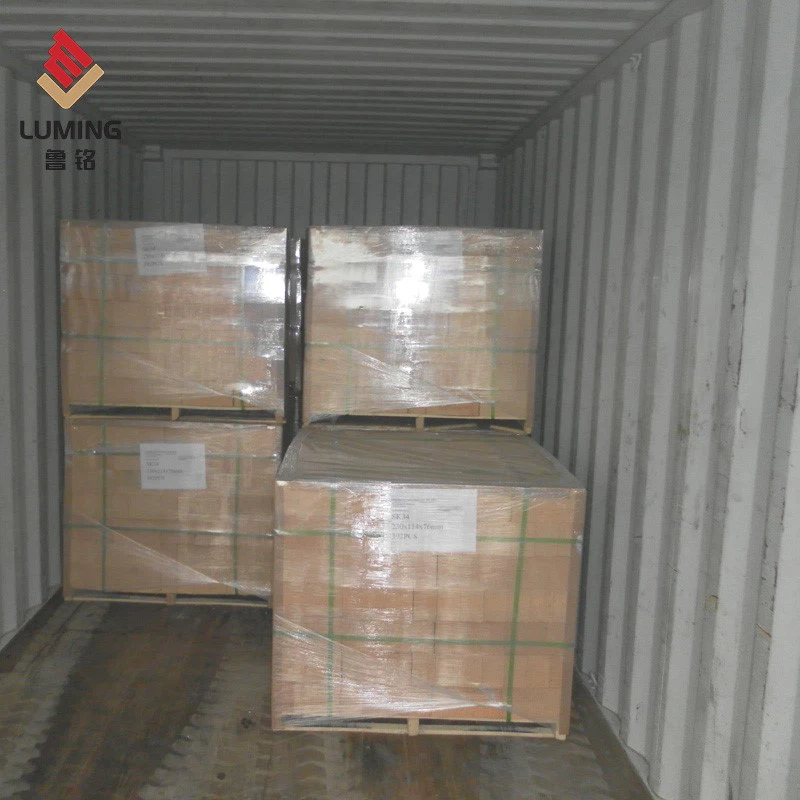
Packaging and Shipping of Phosphate Bonded Alumina Brick
1.Packed on wooden pallets with moisture-proof film to prevent damage.
2.Keep in dry, ventilated areas.
Our Company


FAQ
Hot Tags: phosphate-bonded high alumina brick, China phosphate-bonded high alumina brick manufacturers, suppliers, factory, Phosphate-bonded Corundum Brick, Phosphate-bonded Composite Brick, High Aluminium Phosphate Bonded Abrasion Resistant Brick, Phosphate-bonded High Alumina Brick, phosphate-bonded brick, Ceramic Brick


